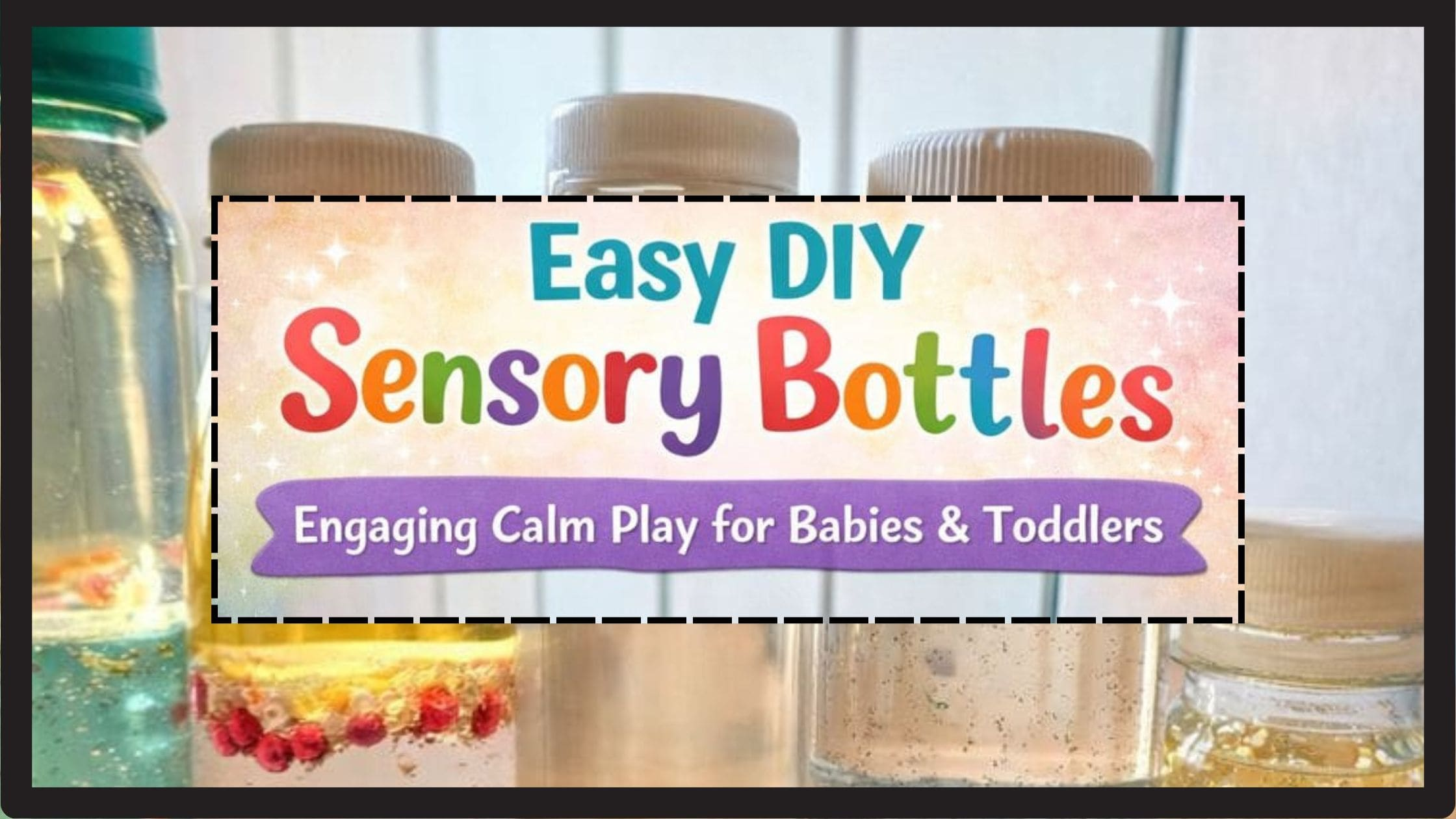
Sensory bottles were never a “quick activity” for us — they were something I made intentionally for my baby, to capture his attention, help him focus, and calm him.
My son is almost 29 months now and still enjoys them, but I see sensory bottles mainly as a baby to young toddler activity, especially because little ones are completely fascinated by movement and…
of course the glitter.
I’m already planning to make new ones for my second, because they were one of the few things that could truly hold my baby’s attention.

- 🎯 What You’ll Need to Make Sensory Bottles (Flexible & Honest)
- 🛠️ How I Actually Make Sensory Bottles For Babies and Toddlers
- 🔐 Safety & Sealing (What I Really Do)
- 🎯 How Babies & Toddlers Play With Sensory Bottles
- 🧠 What They’re Learning Through Sensory Bottles
- 🎲 Sensory Bottle Activities & On-the-Go Use
- 👶 Age-Appropriate Sensory Bottle Use
- 📌 My Honest Thoughts
- 📍 FAQs About Sensory Bottles
- 🔗 Related Resources
- 💬 Your Turn
- Enjoyed This Post? Here’s How You Can Help!
- Latest Posts:
🎯 What You’ll Need to Make Sensory Bottles (Flexible & Honest)
To be honest my sensory bottles took a lot of trial and errors. The first 3 I didn’t particularily like. But these days I do them in a specific way and they turn out well.
Basic materials :
- Clear plastic bottles. (I usually use smoothie bottles they fit well into toddler hands.) And you can just take of the etiquette and they are clear. It should be a sturdy one.
- > Many people love VOSS bottles, you can get them at Wal-Mart, Kroger, Whole Foods, and of course online at Amazon, this is their smallest one
. They are a bit big for me, they do have a wide opening thought which is nice, especially for older kids.
Liquids:
I have tried a lot of liquids, from sunflower oil to glue. I am the happiest with clear baby oil. The cheap one. I once tried shower oil and it bubbled and doesn’t work at all. Sunflower oil works fine, just has a bit of a yellow tinge. Here is what you can use:
- Water – The very basic. It doesn’t work well with magnets and things that can rust. Obejects move fast.
- Colored Water – With liquid watercolor or food coloring. In my experience it makes the liquid a bit blurry, so add sparingly.
- Baby Oil – I get this in Germany at the dollar store usually. Of course you can also get it online on Amazon, that’s a bit expensive thought
- Cooking Oil – This works well if you have Oil Dye
or it’ll keep the tinge.
- Liquid Soap – Also works well, I didn’t combine it with water.
- Clear Glue – slows object down quiet well.
Fillers we’ve used over time:
- Glitter, sequins, beads, buttons
- Small toys
- Rice, lentils, chickpeas, nuts
- Pom poms
- Small figurines
- Natural items (stones, leaves, sands, shells)

💡 I usually start by deciding whether it’s a wet or dry bottle, then build from there.
👉 Here is where I get my sensory bottle materials cheap.
🧴 Our Sensory Bottle Categories
Here are all the categories we’ve tried and loved before:
🌈 Visual Sensory Bottles
Best for babies and young toddlers who love movement and sparkle. Basically these are baby safe snow globes.
👉 Ideas & tutorials:


🔊 Sound Sensory Bottles
Perfect for babies discovering cause & effect. Or babies who love music. <3

❄️🌸 Seasonal Sensory Bottles
These keep sensory play fresh and meaningful. 👉 Seasonal ideas:


🛠️ How I Actually Make Sensory Bottles For Babies and Toddlers
This is my real process — not a rushed version.
- Choose the bottle first (this determines everything).
- Add the base:
- Oil or water for wet bottles
- Nothing for dry bottles
- Slowly add fillers until the movement feels right. I love layered bottles and I do about half water, half oil and leave a tiny space at the top so the liquids can still move.
- Close the lid (not seal it) and test it yourself.
- Adjust if needed — this part takes time, and that’s okay.
- Seal the lid.
Those bottles can survive years. I keep them and use them again and again.
🔐 Safety & Sealing (What I Really Do)
When my son was a baby, I didn’t always glue the lids — it honestly wasn’t necessary at that stage. Now that he’s a toddler and tries to open everything, I:
- Seal with glue and
- Wrap the lid with electrician’s tape
Even now, he still checks if he can open them — so sealing matters more with age.
🎯 How Babies & Toddlers Play With Sensory Bottles
As a baby, my son:
- Shook the bottles
- Watched glitter move
- Stayed focused for 20 minutes or more
Now, as a toddler:
- He still shakes them
- He tells me what’s inside
- He compares bottles
- He chooses favorites
We keep all our sensory bottles in a cupboard, and sometimes he opens it on his own and revisits bottles we made when he was a baby. It’s been fascinating to watch how his interaction changed over time.
HERE ARE: SENSORY BOTTLE GAMES YOU CAN PLAY.
🧠 What They’re Learning Through Sensory Bottles
Sensory bottles support learning in a very quiet, natural way:
- Visual tracking
- Cause & effect
- Focus and attention span
- Early vocabulary (shake, glitter, oil, slow, fast)
- Observation skills
They’re not flashy learning tools — but they’re powerful for early development.
🎲 Sensory Bottle Activities & On-the-Go Use
One of the biggest benefits of sensory bottles is that they’re:
- Portable
- Quiet
- Self-contained
We’ve used them:
- In waiting rooms
- On outings
- During calm-down moments at home
👉 More ideas: Mess-Free Sensory Play Ideas
👶 Age-Appropriate Sensory Bottle Use
- Babies (6–18 months): simple visuals, big fillers, strong contrast
- Young toddlers (18–30 months): sound, themed, seasonal bottles
- Older toddlers: still enjoy them, but usually as a calmer option
📌 My Honest Thoughts
Sensory bottles take time to make — and that’s okay. For us, they were worth it, especially during the baby phase when finding something engaging felt hard.
Each one was made with love, at first I didn’t believe they’d work— seeing my toddler still revisit them now makes that effort feel meaningful.
📍 FAQs About Sensory Bottles
Q: Are sensory bottles mainly for babies?
A: Yes — they’re most powerful for babies and young toddlers, though older toddlers may still enjoy them.
Q: Are sensory bottles good for travel?
A: Absolutely — that’s one of their biggest strengths.
🔗 Related Resources
Related: Ultimate Sensory Play Guide for Toddlers
A complete overview of sensory activities — from babies to older toddlers. (link later)
Related: Sensory Bin Ideas -That will keep your toddler busy for hours.
💬 Your Turn
Did you use sensory bottles with your baby too?
Tag #mommyscrafttime on Pinterest, Instagram, TikTok, Facebook, or YouTube — I love seeing how others adapt these ideas.
✨ Looking for intentional toddler activities that actually fit real life? Want to chat or hang out, have some mommy friends?
👉 Join my Skool community for support, ideas, and honest parenting conversations:
Enjoyed This Post? Here’s How You Can Help!

If you enjoyed this post, please take 60 seconds to tell a friend.
Whether it’s a quick mention in a mom’s group, sharing on social media, or chatting about it with friends, every share makes a big difference.
I spend many hours crafting posts like this.
Every little helps, and I rely on people like yourself to help grow traffic!📌 Pin now, read later!
Latest Posts:

Ice Cream Pipette Painting Activity for Toddlers (Easy Summer Fun!)

Castle Suncatcher Craft for Toddlers (Easy & Beautiful!)

Easy Balloon Painting Lion Craft for Toddlers (Safari Art)
Sometimes toddlers just want to do something right now, and there’s no time for complicated…

This Easy Fish Suncatcher Craft Kept My Toddler Busy 20-Minutes
Need a super simple indoor toddler craft when you’re honestly too tired to plan anything…

How I Taught My Toddler Colors With These Simple Play Activities
I thought teaching colors would be easy. You know… point at something red and say…

Ocean Diorama for Toddlers (Easy Recycled Craft)
Sometimes I want to do a craft with my toddler, but I also wonder… is…